Tuesday, November 2, 2010

Rome Sacked/ Falls to Barbarians

Interviewer: "Hello sir, can you  tell me what happened here?"

Citizen of Rome: "Rome was...sacked!"

Interviewer: "Please, tell me the story from the beginning."

Citizen: "Alright, I will tell you the story of the Visigoths. It all really started with the Battle of Adrianople 378 A.D.  Rome had an embarrassing lose to the Goths. After that, our emperor Theodosius I put many of them in the Roman Army.  When he died, that's when the barbarians broke Rome's treaty and selected a new leader: Alaric.  Alaric started after Greece, then Italy in 401. He lost, however, and again in 403 so he left Italy.  In 408, Rome was having some power troubles, so Alaric decided to go after Italy.  Lucky for him, the Western Roman emperor, Honorius, had the great Roman general killed resently before.  Honorius also had many other barbarians killed and the remaining actually joined Alaric's troops.  By 409, the Visigoths had surrounded Rome, but Alaric took a tribute and left.  After spending a hard winter away, Alaric demanded more from the Romans.  When Honorius refused, the Visigoths in 410 once again had Rome as a target.  An alli of Alaric opened the gates of Rome on August 24th and the barbarian army raided the empire for three days.  They didn't find any food because us Romans have been starving ourselves, and they left most of our architecture in tact. And now here I stand today, the once great empire of Rome, destroyed."

Interviewer: "Can you please tell me what you think the impact of this event will be?"

Citizen: "Terrible things!  This was the greatest empire ever; our people have no protection!"

Interviewer: "Wow, this might be a great impact on the world just because you all think that you are so vulnerable."

Citizen: "Maybe some of it is in our heads, but this establishment has been in power for almost 800 years!"

Interviewer: "Yes, and who knows what life will be like without any emperor of our society"

Citizen: "Madness"

Interviewer: "Well, thank you for the interview."

Picture of Alaric, the Visigoth's king.  The Fall of Rome unofficially starts what is known as the "Dark Ages' of Europe and the Roman Empire was completely gone by 476.


("sack of Rome." World History: Ancient and Medieval Eras. ABC-CLIO, 2010. Web. 2 Nov. 2010.")

Monday, November 1, 2010

Constantine the Great

Interviewer: "Greetings Constantine, it is a real honor to meet you. Just as Alexander had done, can you please tell me your stroy?"
Constantine the Great: "Indeed.  I was born in Naissus son of Helen, or saint Helen as you may know her.  At the time, the emperor was Diocletian and coemperor was Maximian.  My father, Constantius I later became coemperor when Diocletian and Maximian abdicated in 305 A.D.  My father then died in 306 and with the military's favor, I competed for leadership.  In 312 I defeated Maxentius in the Battle of Milvian Bridge and gained control of the Western Romen Empire. When I defeated Licinius in 324, I was left to rule all of the great Roman Empire. "

Interviewer: "Whoa"

Constantine: "Yeah. I made the capital Constantinople in Byzantium, but a more memorable thing had happened to me durring the Battle of Milvian Bridge.  The day before I had had a dream where I had seen our victory and a Christian Cross.  The reason I had won that battle was because of God. Ending the persecution of Christians, I converted. I alowed freedom of religioin, but many other Romans converted too."

Interviewer: "Now, would you say your greatest achievement would be your spread of Christianity?"

Constantine:  "Yes, I also built many monuments like churches, cities, and the Arch Constantine. 
Constantinople was a wonderful city, if I do say so myself, and with a new capital it helped to unify Rome
after the fall of the Latin West"

Interviewer:  "Well thank you for the interview"

Constantine:  "You're welcome"

Interviewer: "What a saint"


("Constantine the Great." World History: Ancient and Medieval Eras. ABC-CLIO, 2010. Web. 1 Nov. 2010.")

Saturday, October 30, 2010

Julius Caesar/Fall of Roman Republic

Interviewer: "Greetings Julius, how are you?"

Julius Caesar: "Well"

Interviewer: "Do you think you would mind telling me how you ended the Roman Republic?"

Julius: "No, I would not. Shall I start from the beginning?"

Interviewer: "Sure"

Julius:  "I was born in 100 B.C. in a patrician family, meaning we were of a land-owning upper class that was involved in the Senate.  I spent my childhood in Asia Minor and returned to Greece in 73 B.C.  I was a pontifex, or priest, and climbed from military tribune to quaestor.  When my wife and Aunt died, I broke the tradition of not having women public funerals. With that, people began to notice my political importance.  I later followed the agitation of northern Italian Latin colonies for Roman citizenship and supported Pompey the Great.  Pompey, Marcus Crassus, and I later formed the First Triumvirate.  I gained a lot of respect in that time period, including Cicero and Cato the Younger.  I was then a praetor and, although in some financial troubles, focused my attention on Spain and other tribes. A lot of cash was made after that project.  Eventually, I was elected consulship in 58 B.C."

Interviewer:  "Is that the election that you cheated and used physical force to persuade your followers?"

Julius: "Let me continue my story!  Where was I? Yes, I had just put the First Triumvirate into action and had all my allies-supporters put in their proper position in the government.  Now, by then people were starting to tell that I did not like their republic laws. Some even tried to persecute me! They failed, of course, but I moved onto a more violent stage in my career.  I ran a great Roman army, called legions, in which had the whole country fearful.  Then, in 55 B.C. my old buddies Pompey and Crassus joined me in the consul.  Unfortunately, Crassus died, Pompey was kept away from me, and my five year term was coming to an end.  In 49 B.C., I crossed the Rubicon River, showing that I meant war and no laws were going to stop me.  Many battles and thousand of Romans later, I had finally destroyed the republic.One ironic thing is that the leader of the Republicans was Pompey"

Interviewer: "Hmm, and that was last year, wasn't it?"

Julius:  "Yes, 45 B.C."

Interviewer:  "And here you stand, the current dictator of Rome until you die."

Julius: "Until I die-I guess you could say that."

Interviewer: "So Julius Caesar, why would you say you are important to Rome's history?"

Julius:  "Did you not hear me? I ended the Republic and I was a major political figure."

Interviewer: "Aha well thank you for the interview"

Julius: "You're welcome"

March 14th 44 B.C. Julius Caesar is assassinated by his senate members.


("Julius Caesar." World History: Ancient and Medieval Eras. ABC-CLIO, 2010. Web. 30 Oct. 2010. )

Alexander the Great

Interviewer: "Good morning Alexander, I have heard many great things about you."
Alexander the Great: "I'm sure you have"
Interviewer: "Yes, well, could you please tell me your story?"
Alex: "Yes, of course.  I was born 356 B.C. in Macedonia, son of the well-known Phillip II.  I was a student to Aristotle, and when my father was assasinated in 336, I became king.  I greatly wanted to defeat Persia, for my father, but would have something else to worry about: Thebes. Fortunately, I easily put down their rebellion and went on to Persia.  In the Battle of the Granicus, my army beat the Persians by the river and my reputation climbed.  Next was the battle of Issus, which was another win for the Macedonians.  I had my army fighting with spears called sarissas, making them beg for mercy.  When they asked, I said nah and headed to Egypt.  The Egyptians loved me! Although I knew it all along, they concluded my destiny: I was a God.  They made me pharaoh.  Later, I defeated Persian Empire at Arbela in 331 B.C. and became king when Darius III was killed by his own court.  After that, victories were piling up as far as the Indus valley in 325 B.C and I began to spread my western culture- Greek culture." 
Interviewer: " And then.."
Alex: "And then what?"
Interviewer: "You went back to Babylonia"
Alex: "Yes, well, when I came to Babylonia in 324, the people were not very pleased. Although I was spreading wonderful Greek culture, I had also adapted many Persian."
Interviewer: "How upset are they?"
Alex: "Any other questions?"
Interviewer: "Yes, Alexander, why would you say you are so important?"
Alex: "Why, I'm inspirational!"
Interviewer: "Who do you think you are inspiring?"
Alex: "Other great rulers, I suppose. Also I concider my spreading of greek culture immensely important and my policies"
Interviewer: "Well, thank you for the interview"
Alex: "Yup"
Alexander the Great inspired Julius Caesar and many other people, even up to modern times. Alexander the Great dies at the age of 32.

Alexander the Great:


("Alexander the Great." World History: Ancient and Medieval Eras. ABC-CLIO, 2010. Web. 30 Oct. 2010. )

Friday, October 29, 2010

Axis Age/ Golden Age of Greece

Interviewer: "Hello sir, what is your name?"
kid: "umm... Demokritos"
Interviewer: "Yasou Demokritos, how are you today?"
Demokritos: "I'm doing great"
Interviewer: "Can you tell me what year it is?"
Demokritos: "yeah, it's 320 B.C."
Interviewer: "And can you tell me how Greece is doing currently?"
Demokritos: "Greece is doing woderful, especially here in Athens"
Interviewer: "People call this the 'Golden Age' of Greece, can you tell me why?"
Demokritos: "Well, it all started at about 500 B.C. This has been a great time of government, art, philosophy, drama and poetry accomplishments. Athens adapted the new government style called democracy and it is when the government is ruled by the people.  This was under the rule of Pericles (460-429 B.C.) who also had major architectural acheivments: The Parthenon and the Acropolis.  The making of a greek theatre inspired wonderful playwriters and philosophers. Some great people that were alive during this age were Plato, Socrates, Aristotle, and Pythagrius.  Pythagrius, Hippocrates, Hippias, and Democritusa were all great mathematicians.  Socrate created the Socratic method and Aristotle was a mathematic writer.  There were also improvements in science and medicine."  
Interviewer: "Now I've also heard this been called the Golden Stone age of Greece,why is that?"
Demokritos: "See here, there are wonderful statues and pottery creations right now." 
Interviewer: "Ah. Can you tell me why this time is important?"
Demokritos: "Important?! These ideas are huge! The impact on Greece is colossal, not to mention the rest of the world"
Interviewer: "The rest of the world?"
Demokritos: "Who wouldn't want a democracy?"
Interviewer: "True, and to know more mathmetical facts like a2+b2=c2.  Thank you for this interview."
Demokritos: "You're welcome"
The Golden Age of Greece/ Axis Age ended 300 B.C. and Greek ideas become the basis of Western poitics.


Picture of the Parthenon in present Athens, Greece.


("Golden Age of Greece." Maps of World.com (2009): n. pag. Web. 30 Oct 2010.
"Early Greek Mathematics (650 B.C.-400 B.C.)." Oracle ThinkQuest (2001): n. pag. Web. 30 Oct 2010.)

Wednesday, October 20, 2010

Zheng He

Dear Online Journal,
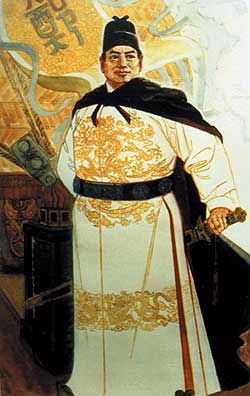
It is the year 1437, just two years after Zheng He's death.  China has decided to burn all of his fleet of war ships and not to worry about the outside world.   We decided to focus on China's interior and keep the Chinese in, even banning the building of seagoing ships.  Unfortunately, our old school ways have actually weakened us and we are relatively open to foreign invasion.  You can tell that the other countries, such as the British, want to take us over.   And although his fame is trying to be covered up, Zheng He did great work under the building and sailing of the ships.  He worked as the emperor's admiral and from 1405 to 1433, he completed seven voyages. Before his first voyage, Zheng He created 2,000 vessels for all different purposes, which included the great "treasure ships".  These ships were 400 feet long and 150 feet wide; some of the largest wooden ships ever created.  On this first voyage he ventured to India, but stopped to trade at places like Champa and Java.  They also defeated a major pirate at the time, called Chen Zuyi, and had him killed.  These started many political relationships.  Other voyages took him to the Arabian Peninsula, Africa, and many other far away places.  Zheng He was born in 1371, and served China well.
Chi Fu

ABC-CLIO, 2010. Web. 20 Oct. 2010. <http://ancienthistory.abc-clio.com/>

Sung Dynasty


Dear Online Journal,
(Sigh) Today is a sad day in China History. It is 1279 and the Mongols just ended the Southern Sung Dynasty, China's Golden Age.  The greatness started in 960 AD, when the great General Zhao Kuangyin reunited China and started the Sung Dynasty.  We purchased a new kind of fast –growing rice which doubled our number of crop seasons!(2) With this surplus in food, China was free to express themselves. Therefore, there was much great advancement made over the past 300 years.  I am a writer and am happy to state that wood blocking for printing become much more popular and therefore made printing easier.  With more available books, more people learned to read and I sold a good number of my books!  Poetry also improved with great poets such as Du Fu and Li-Po. Other culture areas were also visited during this era, like literature and religion.  There were also economic, educational, artistic, and some governmental developments during the past dynasty.  With the invention of paper money, gun powder, and other things such as the mechanical clock, trading boomed!  We were trading with countries such as India, Pakistan, and Arabia.  Manufacturing and commerce also advanced throughout China. The Civil system added more Confucius texts, a great decision, and I hope that China will continue to develop and become a better place. 
~Chung Li     

"Song dynasty." World History: Ancient and Medieval Eras. ABC-CLIO, 2010. Web. 18 Oct. 2010. <http://ancienthistory.abc-clio.com/>